Casting
Die casting
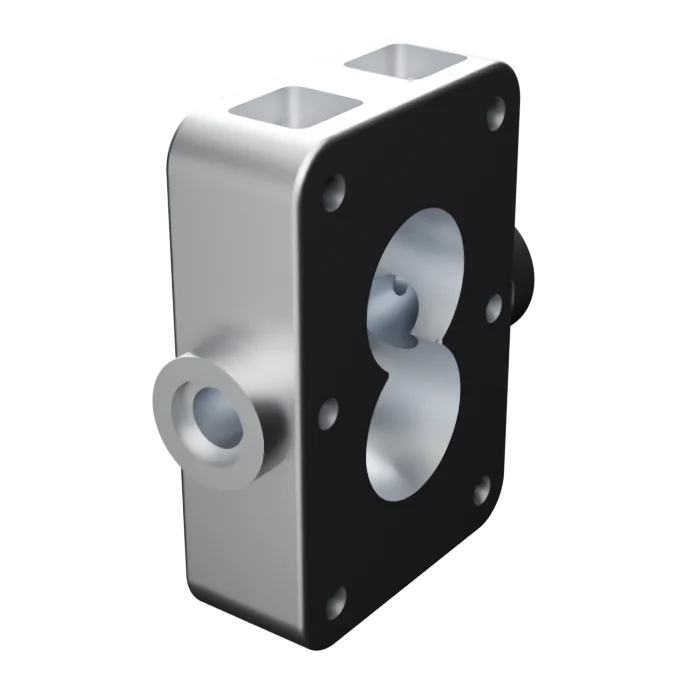
Aluminium and zinc – with CNC finishing of functional faces.
Process
How a part is made.
- Design for castingDraft angles, radii, wall thicknesses and gating are agreed before die making.
- Die makingThe die is made from hot-work steel with cores and slides for cavities.
- Casting & trimmingThe melt is injected at high speed; runner and flash are removed.
- CNC finishingSealing, bearing and mating faces and threads are milled; then surface treatment such as powder coating.
Materials
Which materials are common?
| Alloy | Standard / designation | Typical application |
|---|---|---|
| AlSi9Cu3(Fe) | EN AC-46000 | Standard alloy for housings and engine parts |
| AlSi12(Fe) | EN AC-44300 | Thin-walled, pressure-tight parts |
| AlSi10Mg | EN AC-43400 / 43000 | Higher strength, heat-treatable |
| Zamak 5 | ZP0410 (ZnAl4Cu1) | Small, detailed parts, fittings |
| Zamak 3 | ZP0400 (ZnAl4) | Dimensionally stable parts, electroplatable |
Guide values
Tolerances and finishes
| Feature | Guide value |
|---|---|
| Tolerance | Casting tolerance to ISO 8062-3; machined faces to drawing |
| Wall thickness | Aluminium approx. 1.5 – 4 mm, zinc from approx. 0.8 mm |
| Draft angle | Aluminium approx. 1 – 2°, zinc approx. 0.5 – 1° |
| Machining allowance | approx. 0.5 – 1 mm on functional faces |
| Finishes | Blasting, powder coating, painting, chromating; zinc electroplated |
| Inspection | Measurement report, X-ray or leak test on request |
* Typical guide values. What applies to your part we confirm in the quote based on the drawing.
Design
Six rules for cost-effective parts.
Most costs are fixed in the design. We check these rules in every quote as DFM notes.
What drives the price
- Die: size, cores, slides, cavities
- Part weight and alloy price
- Scope of CNC finishing
- Surface treatment, leak or X-ray testing
FAQ
Questions about die casting
Aluminium or zinc die casting?
Aluminium is lighter and usual for larger housings. Zinc allows thinner walls, finer details and tighter casting tolerances – ideal for small parts – but is heavier.
Are die-cast parts leak-tight?
With a suitable alloy, design and process control, yes; for oil and gas tightness we agree a leak test.
Why do die-cast parts need machining?
Casting tolerances are coarser than machining tolerances. Bearing, sealing and mating faces are therefore CNC machined after casting.
Other processes:
From the factory
What Die casting looks like in production.
Original footage from the Schutawill company video – the machines and people who make your parts. No sound.
Your drawing.
Our quote.
Upload STEP or PDF – you receive feasibility, process, tooling cost, unit price and lead time.
Upload a drawing- Quote with DFM notes – non-binding
- NDA before the first exchange
- First articles with measurement report