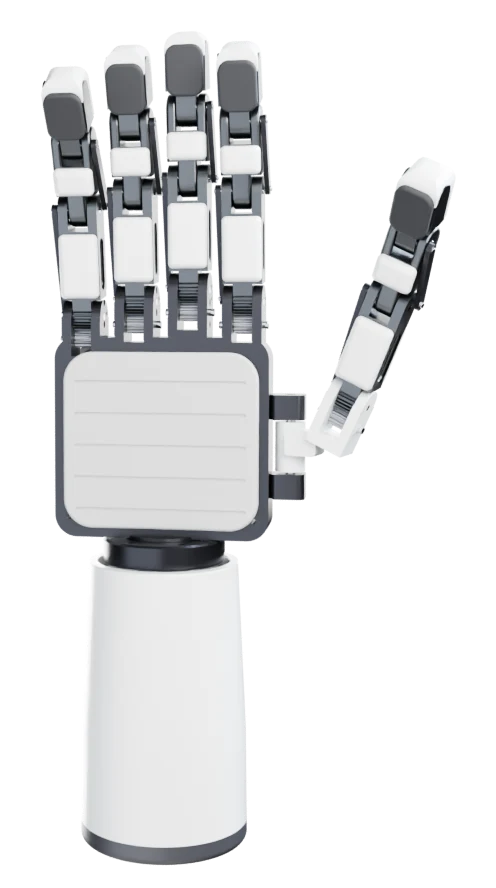
Our robotic hand SW-RH5 consists of 111 parts – each of them manufacturable with our processes. It is not a product; it shows how we match an assembly to manufacturing part by part.
17-4PH
Small, strong and geometrically dense: gearing, lightening windows and the arc slot are formed in one shot. Milled, each link would need several set-ups – with 15 links per hand the tool pays off.
Small quantity: Prototypes milled from solid 17-4PH. From a few thousand pieces a year the MIM tool pays off.
STEP: Grundglied · Mittelglied · Endglied
17-4PH
Flat part with two accurate eyes, ten per hand. MIM delivers the bores ready to assemble and the edges burr-free.
Small quantity: Wire-EDM or milled. At very high quantities, stamping via a partner factory is the alternative.
STEP: Koppelstange
PC/ABS white
Thin 1.6 mm wall, snap hooks and a visible matt surface: the strength of injection moulding. The colour is in the material, nothing is painted.
Small quantity: Milled ABS prototypes to check fit and grip before the steel tool is built.
STEP: Fingerschale Grundglied · Fingerschale Mittelglied · Handrueckenschale
PC/ABS white · TPE
The tip is overmoulded directly onto the MIM end link, the soft TPE pad on top. No gluing, and the tip cannot come loose.
Small quantity: Single parts milled and glued – for functional prototypes only.
STEP: Fingerkuppe · Kuppenpolster · Handflaechenpolster
1.4305 · 42CrMo4
Rotationally symmetric with h7 fit and grooves for retaining rings: classic bar-turned parts without tooling cost. 1.4305 machines very well.
Small quantity: Same process – turning pays off from a few pieces.
STEP: Gelenkbolzen · Koppelstift · Ritzelwelle · Daumenachse · Handgelenkwelle
EN AW-6082
Ring-shaped aluminium part with bearing seat and screw joint, turned in one set-up and then black anodised.
Small quantity: Same process.
STEP: Lagerring
Sintered steel Fe-Cu-C
The gearing comes finished out of the press tool, no tooth is cut. With five pinions per hand and a fixed geometry, sintering is the cheapest process.
Small quantity: Hobbed from steel. Switching to sintered parts pays off from a few thousand pieces.
STEP: Antriebsritzel
Sintered bronze CuSn10
Here the porosity is the function: the sintered bronze is oil-impregnated and lubricates the bearing itself over its lifetime.
Small quantity: Standard sintered bronze bushes or turned bushes from bearing bronze.
STEP: Gleitlagerbuchse
Zinc ZP0410 (Zamak 5)
Small part with joint fork, bearing eye and fine details. Zinc fills thin walls cleanly, the tool lasts very long and the surface powder-coats well.
Small quantity: Milled from aluminium.
STEP: Daumentraeger
AlSi10Mg
Large conical shell with inner ribs and bearing webs: as a milled part most of the block would turn into chips. In die casting the ribs come free; only the bearing seats are machined.
Small quantity: Milled from solid – expensive per piece, but no tool.
STEP: Unterarmschale
EN AW-7075
One part per hand, but the most accurate: five joint forks and all bearing bores must match each other. Milled, they are made from one datum in few set-ups.
Small quantity: Same process. Only for very large series: die casting with milled bores.
STEP: Handteller
PA6-GF30
Stiff plastic part with cable gland. Glass-fibre reinforced PA6 holds the screw joint, the tool is simple.
Small quantity: Milled as a prototype.
STEP: Endkappe
These are design considerations on our own example, not a price commitment. At which quantity tooling pays off for your part, we calculate in the quote.